For neighbors concerned about the Heritage Hills proposal: turn what you have personally observed into a clear, respectful statement about your home and daily life.
You do not need to be an expert to contribute. Your experience can help the Board understand what is at stake for your home.
About 5–10 minutes. No account. Nothing submitted here.
A PLACE FOR CONCERNED NEIGHBORS TO BE HEARD
Help the Board understand life at your home.
This independent tool is for York Township residents and nearby neighbors who may be personally affected by the Heritage Hills proposal. It helps you prepare an individual statement to read or print. Nothing is submitted to the Township here.
If you have an experience to share, consider speaking up. Describe what you personally observed, how it affected your home or daily life, and what you want the Board to review. Calm, specific examples give others something concrete to consider.
Describe the experience. What happened, where, and approximately when? Use your own observations.
Explain the personal effect. Connect it to your home, access, property conditions, or daily life. Avoid general accusations or assumptions about other people.
Separate future concerns from facts. Explain why an observed experience makes you concerned about a possible future effect, then ask for the relevant evidence or clarification.
You do not need to predict an outcome or speak for everyone. Your own honest, respectful account is enough to begin.
01 Your words, grounded in facts02 Private by design03 Ready to read or print
MAKE IT PERSONAL. KEEP IT ACCURATE.
Let’s build your statement.
Focus on your own experience and its effect on your home or daily life. Be specific and respectful; identify possible future effects as concerns, rather than established facts.
Your draft is only in this page. Refreshing or closing clears it.
COME PREPARED
Context, with the sources attached.
This is an independent resident tool, not a Township or HOA website. It does not determine the outcome of an application.
01 / HEARING
Check the official notice.
The Township calendar lists a Zoning Hearing Board meeting on October 27, 2026 at 6 p.m., 190 Oak Road, Dallastown. Confirm the case-specific notice and changes before attending.
Organizer arrival guidance: doors open around 5:30 p.m.; the hearing starts at 6 p.m. Arrive early and look for the sign-up sheet inside the door if you wish to be heard. Confirm any updates and participation procedures with the Township.
The Heritage Hills topic and target date come from the organizer’s brief. On October 23, the linked October 27 agenda PDF could not be retrieved; the specific case, relief, and hearing location have not been independently confirmed.
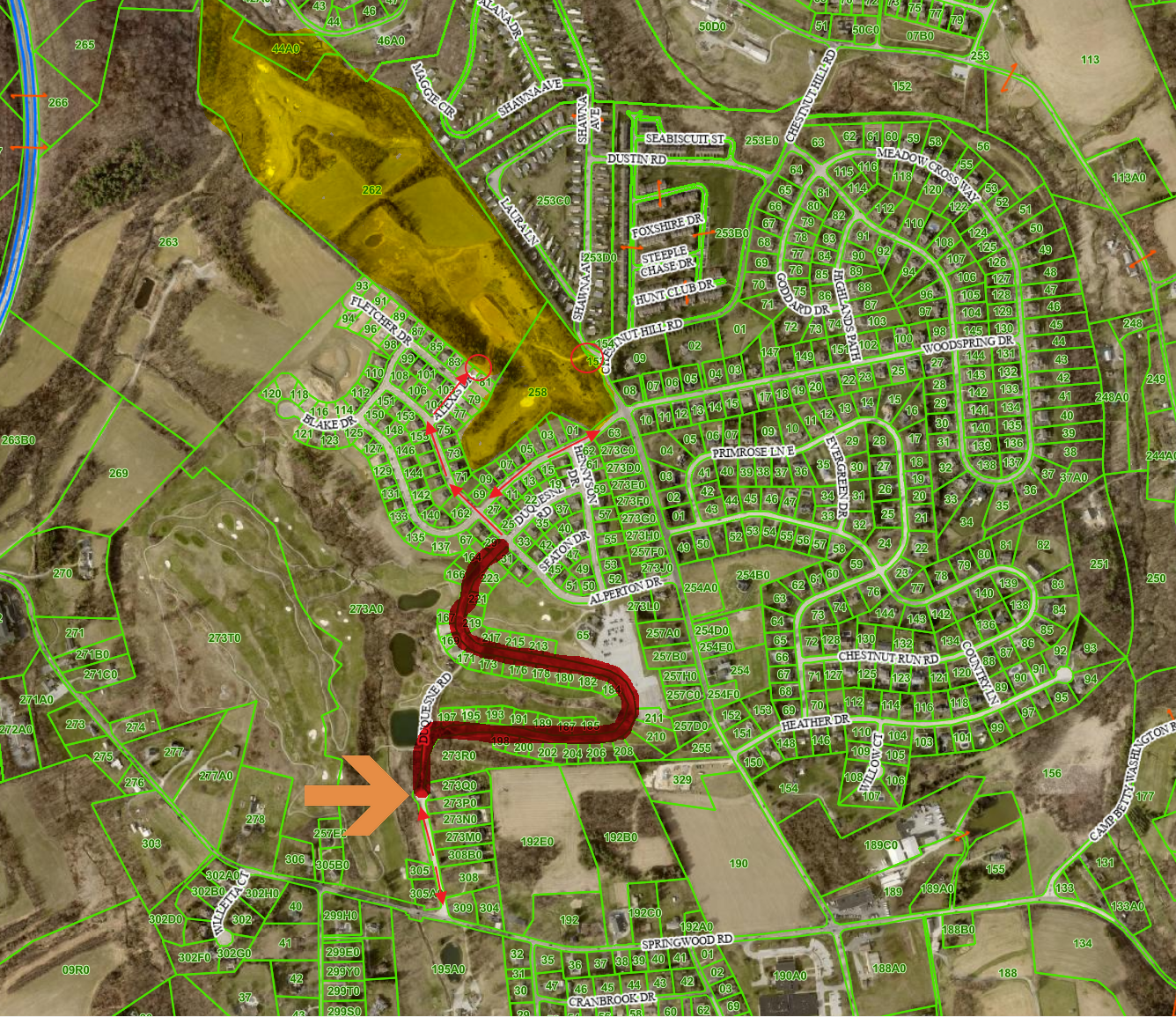
The supplied application describes Shawna Avenue and Alexis Drive access (PDF pages 8 and 52). Its July 23 scoping correspondence refers to Bridgewater Projects 1, 2, and 3 (PDF pages 67–68). Residents also raise questions about a Duquesne Road–Springwood Road connection; the supplied annotated map illustrates that concern.
The packet includes a traffic study. Figures differ across its narrative, sketch, and scoping materials; ask which revisions, unit totals, and road connections are current. These source descriptions do not establish a traffic impact or an omission, and no assumed “70 homes” figure is inserted into your statement.
A general planning report is not a substitute for a case-specific traffic study. Ask which plans, traffic assumptions, zoning provisions, and exhibits are actually before the Board.
Writing help, not legal or engineering advice. Party status, witness questions, admissibility, deadlines, and speaking time depend on applicable rules and Board decisions. Consult the Township or your attorney.
Longer delays at Chestnut Hill & Camp Betty Washington.
At Chestnut Hill Road & Camp Betty Washington Road, the applicant forecasts average intersection control delay rising from 17.3 to 33.3 seconds per vehicle in the 2035 weekday PM peak hour with the proposal, without the modeled improvements.
Increase in average delay
+92.5%Calculated from 17.3 → 33.3 sec/vehicle
Added average delay
+16 sec2035 PM peak hour · build vs. no-build
Calculation: (33.3 − 17.3) ÷ 17.3 × 100 ≈ 92.5%. This is a forecast increase in average delay, not traffic volume or a guaranteed wait for each driver. The modeled overall level of service changes from C to D.
With the modeled improvements: the same table forecasts 23.9 seconds per vehicle (level of service C). Ask which improvements are assumed, who will deliver them, and when they will be in place.
The study’s nearby-development section lists an age-restricted Bridgewater community, and an Appendix E worksheet labels its background-development row “Bridgewater (Remaining Build-Out) Age Restricted.” Neither separately identifies Project 3.
The July 23 scoping letter discusses Projects 1–3 and separately describes the age-restricted Project 4. Ask the applicant to show where remaining Project 3 traffic and future road connections are included, or update the analysis if they are absent. These page labels alone do not establish that Project 3 was excluded.
Review the material yourself before citing it. Document statements and marked-up images are separate from your firsthand experience.
PDF304 PAGES
Heritage Hills special exception application
Full packet supplied by the site organizer, including the application, supplemental narrative, deeds, sketch plans, traffic study, and correspondence. The cover letter is dated September 14, 2026. The filename’s “2026-12” label is not independent confirmation of a case number.
13.9 MB · Original supplied PDF · Contents are applicant/submission materials, not Board findings or proof of approval. Confirm the latest official version and hearing notice with the Township.
The narrative describes Shawna Avenue and Alexis Drive connections (PDF 8). The traffic study’s printed page 7 (PDF 50) sets out background-development assumptions. The July 23 correspondence discusses Bridgewater Projects 1, 2, and 3 and separately describes Project 4 (PDF 67–68).
Unit figures vary even within the narrative on PDF 7–8, and across the sketch and earlier scoping correspondence. A useful request is to reconcile the versions and explain which development and road-network assumptions the current analysis uses. Differences alone do not prove an error, omission, or motive.
This is a reading guide, not an engineering or legal review of the entire 304-page packet. No statement automatically claims that you reviewed it.
SUPPLIED PLAN IMAGE
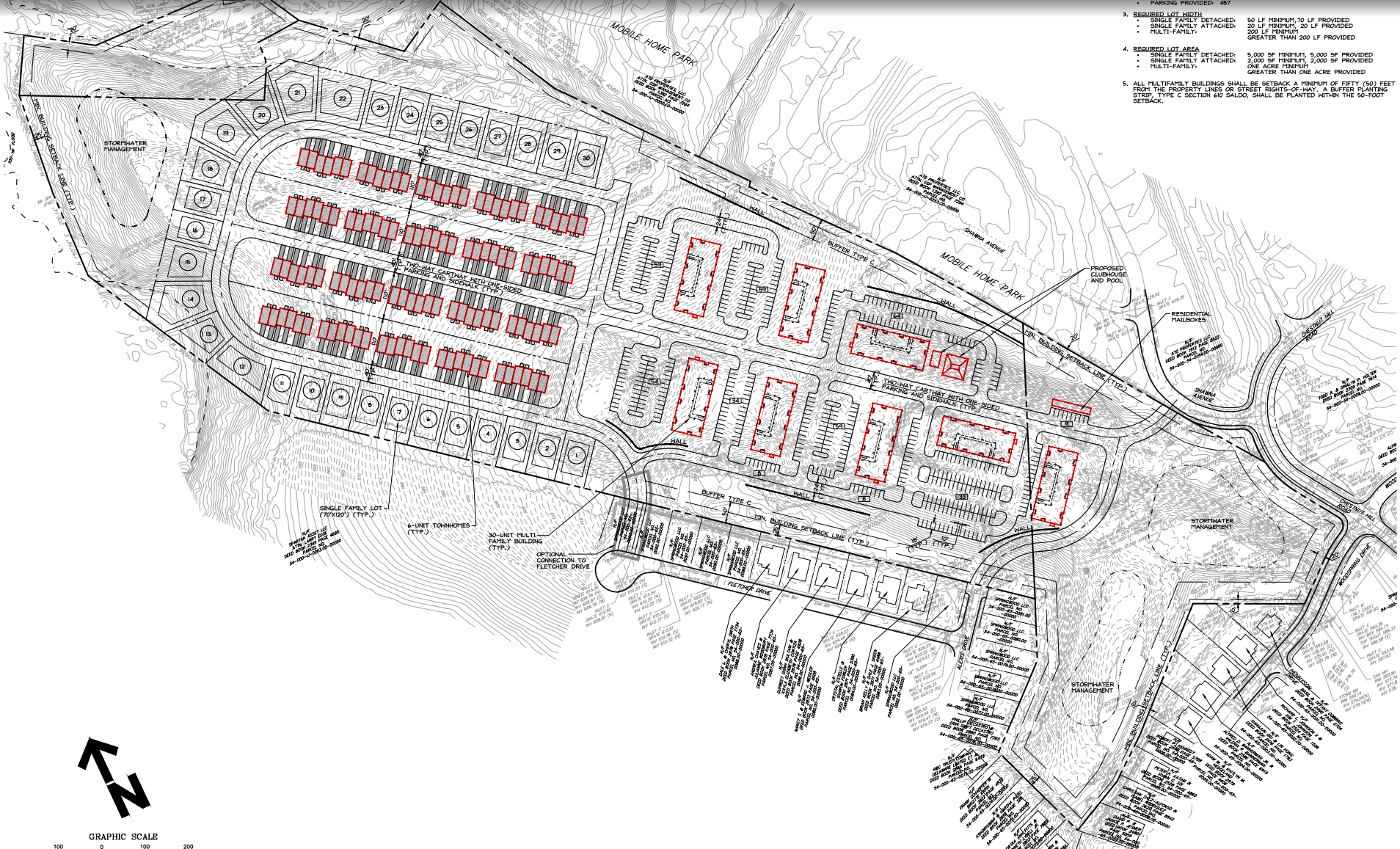
Proposed development layout
Use this image to locate features and frame questions. Its date, revision, approval status, and consistency with the current application have not been independently established. Open the original to read the fine print.
The colored route, circles, highlight, and arrow are supplied annotations illustrating a concern. They do not independently establish an approved connection, property boundary, road opening, traffic movement, or engineering conclusion. This image is not presented as a certified survey.
In step 3, add only a source you personally reviewed. Include the document title, its date or revision if known, the exhibit, the printed page and PDF viewer page, and the specific passage you mean. Describe the author’s claim as a claim; keep your own observations separate.
For example: “Heritage Hills Associates special exception packet, Exhibit E, TPD Transportation Impact Study dated August 31, 2026, printed page 7 (PDF page 50).” For an image, say “organizer-supplied plan image” or “organizer-supplied annotated context map” and identify the feature you reviewed. Do not infer scale, legal boundaries, approval, or traffic volumes from an image alone.
The builder works in your browser. It has no submission endpoint, accounts, analytics, tracking cookies, external fonts, or automatic draft storage. It does not transmit what you type.
Opening the site contacts its host, which may keep ordinary access logs such as IP addresses. Source links contact those websites. Your browser, device, downloads, and print service have their own privacy behavior. Avoid sensitive information and clear your draft on shared devices.